
As harvest is starting to wrap up in Iowa and the cooling temperatures are making their appearance right in time for fall activities, it’s time to think of our next field operation, anhydrous ammonia. Anhydrous ammonia is an effective nitrogen fertilizer for Iowa corn production, but successful application takes more than an open field and available equipment. Soil temperature, soil moisture, placement, and safe handling all determine whether an application protects your fertilizer investment, and the people doing the work.
As fall fieldwork progresses, resist the pressure to apply simply because harvest is finished. Let field conditions guide the decision.
When should fall applications begin?
Iowa State University Extension and Outreach recommends waiting until soil temperatures at a 4-inch depth are below 50°F and continuing to trend lower. Check the predicted forecast as a brief cold spell followed by warmer weather can allow nitrogen conversion to accelerate again. Use the Iowa Environmental Mesonet soil temperature maps as a starting point, then confirm conditions in your fields. Air temperature and the first frost are not substitutes for soil measurements.
Why does temperature matter you may ask? After injection, ammonia reacts with soil moisture to form ammonium, which is held by clay and organic matter. Soil microorganisms gradually convert ammonium to nitrate, a form more vulnerable to loss through leaching or through denitrification in saturated soils (Figure 1). Cooler temperatures though do not completely stop this from occurring but slows that conversion.
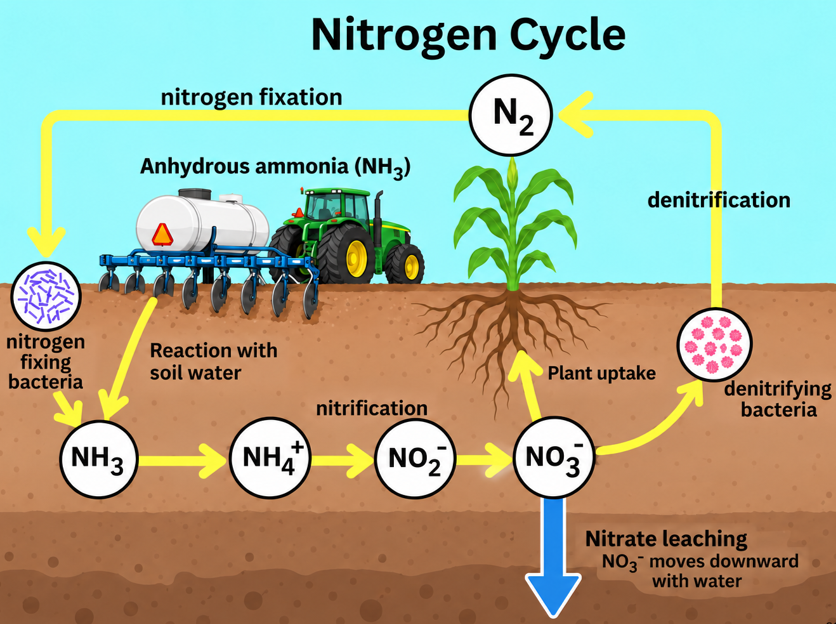
Figure 1. A graphic representation of the nitrogen cycle and how the application of anhydrous ammonia plays a role in this cycle.
Avoid fall applications on sandy, excessively drained soils and poorly drained fields where nitrogen loss risk is greater. Spring or in-season application deserves consideration on those acres.
How should ammonia be applied?
Anhydrous ammonia must be injected into the soil and retained below the surface. A successful application requires adequate depth, suitable moisture, and complete closure behind the knife.
Soil conditions for anhydrous need to be at a “Goldie Locks” condition for moisture. Dry soil is not automatically unsuitable, but dry, cloddy conditions can leave pathways for ammonia to escape. Wet soil can smear along the knife slot and prevent proper sealing. If either condition prevents good closure, wait for better conditions. Iowa State guidance identifies approximately 6–8 inches of injection depth as a useful target, with actual placement adjusted to soil conditions and equipment. Depth alone cannot overcome poor sealing.
Prior to applications:
- Inspect hoses, fittings, knives, and the distribution system; have damaged components repaired before use.
- Check rate control and distribution so nitrogen is delivered uniformly across the toolbar.
- Make a short application pass and assess knife-track closure from a safe position.
- Treat persistent ammonia odor or escaping vapor as a reason to stop and investigate. Never approach a suspected leak to locate it by smell.
What about spring application?
Anhydrous ammonia can also be applied before planting or at sidedressing. For spring preplant applications, protect emerging corn by keeping the ammonia band away from the seed zone. Good soil conditions, adequate injection depth, and separation from future rows reduce injury risk. Waiting several days can help, but there is no universal waiting period that guarantees safety for seedlings. Where placement cannot be controlled relative to future rows, applying at an angle reduces the length of any row exposed to an ammonia band.
Make personal safety part of every application
Anhydrous ammonia can severely injure eyes, skin, and lungs and cause freezing injuries. Before application begins, review safe handling and emergency procedures with everyone involved. A few minutes of preparation can save valuable time if an exposure or equipment failure occurs.
- Write down emergency information for every field. Record the field’s 911 address, entrance location, and directions before application begins. If a field has no assigned address, confirm how to describe its location with your county’s addressing office or emergency management staff ahead of time. Include GPS coordinates as additional information. Keep a printed copy in the tractor and share it with employees and family members; a familiar farm name may mean little to emergency responders.
- Establish a communication plan. Carry a charged phone on your person so it remains accessible if you must leave the tractor quickly. Tell someone which field you are working in, arrange regular check-ins, and agree on what to do if you miss one. Review who will call 911 and provide the field location during an emergency.
- Wear protection before handling connections. Use ammonia-rated gloves, non-vented chemical splash goggles, long sleeves, long pants, and closed-toe footwear. A face shield can provide additional protection but does not replace goggles. Do not wear contact lenses when handling ammonia.
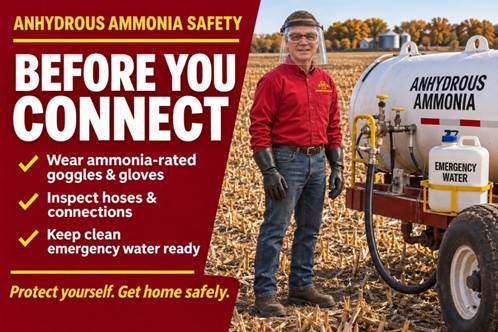
- Check emergency water every day. Each nurse tank must carry at least 5 gallons of clean emergency water. Make sure the container is full, accessible, and unfrozen, and check that water flows from it. Carry a personal eyewash bottle on your body to begin flushing immediately while reaching the larger supply. Keep an additional water supply in the tractor cab during freezing weather.
- Know the wind direction and your escape route. Stay upwind when handling valves and connections and identify a clear route away from a release before starting. Keep bystanders away during hookup and application. Review the manufacturer’s procedures for connecting, disconnecting, and safely relieving trapped pressure; never loosen a fitting or disconnect a hose that remains pressurized.
- Respond immediately to an exposure. Move away from the release to fresh air without entering the ammonia cloud. Begin flushing affected eyes or skin immediately with abundant clean water for at least 15 minutes, and have someone call 911 as soon as possible. Tell dispatch that anhydrous ammonia is involved. Seek immediate medical attention, even after a brief exposure. Do not apply ointments or attempt to neutralize ammonia with another chemical. Never enter a release area to attempt an unprotected rescue; responders need specialized respiratory protection and protective clothing.
A good application window brings together cool soil, suitable moisture, reliable equipment, and prepared operators. If one of those pieces is missing, delaying application can protect both next year’s nitrogen supply and the people working in the field.
Links to this article are strongly encouraged, and this article may be republished without further permission if published as written and if credit is given to the author, Integrated Crop Management News, and Iowa State University Extension and Outreach. If this article is to be used in any other manner, permission from the author is required. This article was originally published on November 3, 2026. The information contained within may not be the most current and accurate depending on when it is accessed.
- Precision Ag Engineer, ISU Digital Ag Innovation Lab

- Digital Agriculture Extension Specialist